
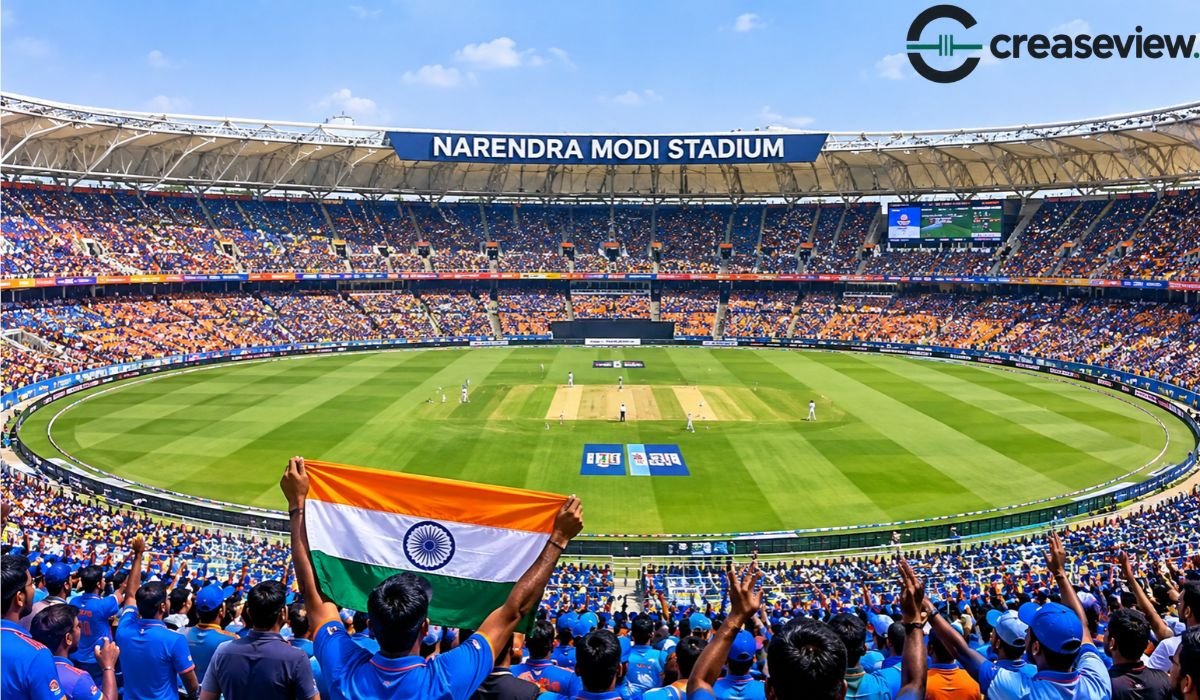
Narendra Modi Stadium, which is situated in Ahmedabad, Gujarat, is a very well-known cricket ground around the globe. This cricket ground is also referred to as the largest cricket stadium in the world due to the number of seats available at this venue, as it accommodates about 1,32,000 people. Many significant international matches, Indian Premier League (IPL) matches, and ICC tournaments were played on this ground. The combination of state-of-the-art facilities, large seating capacity and historical cricket events have turned this into an icon of Indian sport. This stadium was formerly called Sardar Patel Stadium/Motera Stadium; however, it has been renovated and re-opened in 2021.
Narendra Modi Stadium Overview
The Narendra Modi Stadium is located within the Motera neighborhood of Ahmedabad, Gujarat. It had its beginnings as the Sardar Patel Stadium when it opened in 1982. After a large-scale renovation effort, the new stadium was completed in February of 2021 and was renamed after Narendra Modi, the current Prime Minister of India.
The Gujarat Cricket Association (GCA) is the owner and manager of the stadium, and they have control over all cricket related activities and facilities. In addition to being one of the major stadiums used for India’s international home games, it also acts as the home stadium for the Gujarat Titans in the IPL.
This is why it is one of the most popular places to go watch cricket. It has the size, the infrastructure, and the capacity to accommodate a lot of people. It is now a big part of the international tournament scene and a regular host of major cricket events.
Narendra Modi Stadium Capacity and Size
The approximate seating capacity of Narendra Modi Stadium is about 1,32,000 spectators. It is the largest cricket stadium in the world based upon its capacity. The stadium covers approximately 63 acres and was built to provide adequate space for large numbers of people as well as provide the latest amenities for players, officials and guests.
The playing area has many seating options on all sides of it. There are several different stands so that you can see what is happening from any position in the stands. The layout also has modern ways to get into and out of the stadium, which helps when there are many people attending a big event.
The stadium’s seating capacity is much larger than those of other well-known cricket venues such as the Melbourne Cricket Ground (MCG) in Australia with an estimated 100,000 seats and Eden Gardens in Kolkata with an estimated 68,000 seats. As such, the Ahmedabad venue is clearly ahead of all others when it comes to spectator seating capacity.
Due to its great size, modern design, and large seating capacity, this facility has become known as the largest cricket stadium in the world.
History of Narendra Modi Stadium
Construction of the Original Motera Stadium
Sardar Patel Stadium, which was built in 1982, was a replacement of the older international cricket venue in Ahmedabad. This stadium is considered to be one of the most important grounds for Indian cricket. The stadium hosted its first Test match in 1983, with India playing against West Indies.
Over the past few decades, Motera has seen many memorable games and big events. This is why it has become such a popular place for international cricket matches (Tests and ODIs). Many of the best Indian cricketers have played at this location.
The ground is known for several great games played there, but perhaps none was more exciting than the double-century scored by Rahul Dravid in a Test match against Sri Lanka in 2009. The ground has also been used extensively throughout many of India’s international cricket tours, and is therefore very much a part of the nation’s cricketing heritage.
Redevelopment and Modernisation
A major redevelopment project commenced in 2015 for the purpose of transforming the old Motera Ground into a modern, world-class cricket stadium. The reconstruction was completed in 2020, resulting in a much larger facility than previously existed, with enhanced spectator amenities and state-of-the-art infrastructure.
The new stadium was officially opened in February 2021. The name of the new stadium was changed from Sardar Patel Stadium to Narendra Modi Stadium to recognize the service that Narendra Modi provided to the Gujarat Cricket Association while he was the association’s president.
The redevelopment increased the number of seats to about 1,32,000. New dressing rooms, corporate boxes, practice facilities, improved lighting and advanced drainage arrangements were also added. The new stadium was created for hosting international cricket, IPL matches and large-scale sports events.
Narendra Modi Stadium Facilities and Features
The Narendra Modi Stadium has state-of-the-art facilities for players, fans and event coordinators. The stadium’s architecture is built to hold international cricket matches and have capacity for extremely large numbers of people.
Important features include:
- Four dressing rooms: The stadium contains four dressing rooms, which allows for multiple teams to use them and to host tournaments with multiple games.
- 76 luxury suites: These provide upscale seating and dining options for business clients and other guests.
- Practice Facilities: Indoor/outdoor practice facilities allow players to work on their skills prior to participating in a match.
- Modern day LED lighting supports both day time and night time events. It also increases the amount of light that is visible to spectators during the evening.
- The modern drainage system is used by the ground in managing rain delays.
- Spectator facilities: The support of match-day operations through large seating arrangements, dining options, entryways and additional amenities for spectators.
- The location has parking options as well as hospitality services for both regular attendees and those who are considered “special.”
- Sports infrastructure: practice areas and academy-based facilities provide support for the development of cricket as well as for its training.
The stadium has many of the characteristics required to host international matches, national competitions, and other large-scale sporting events.
Narendra Modi Stadium Pitch Report
Depending on how the pitch is prepared, the type of game being played, and the weather, the pitch at Narendra Modi Stadium may be used for a variety of types of games. Many of these pitches are suitable for high scoring batting, and some provide an advantage to spin bowlers, making for a much more competitive match.
Test Match Pitch Report
Test pitches at Narendra Modi Stadium have a tendency to transform significantly during the five-day period of a cricket match. Initially, when the surface is new, batsmen will likely be able to run up scores quickly; however, once the game has been played for several days, batting becomes increasingly difficult.
The use of spin has been a significant factor in many Test matches played on this ground. It is possible for the surface to have some turn and also some variation in bounce, especially as the match progresses. This being said, the way that the surface reacts will depend upon how it was prepared and the state of the match when it is used.
In test cricket, batting partnerships are extremely important. Teams must score a lot of runs (or “build long innings”) and adapt to changing conditions on the pitch. Similarly, bowlers who consistently deliver the ball to a specific area of the pitch (“lines”) and at a consistent height (“lengths”) will apply pressure to the batsmen for longer periods of time.
ODI Pitch Report
The ODI pitch can offer an even playing field for both batsmen and bowlers. Batsmen can produce big scores on a pitch with adequate pace and bounce. Bowlers, on the other hand, can achieve success through varying their pace, bowling cutters and consistently hitting the right line.
Spin bowling can play an important role during the middle overs, especially as the pitch slows down. There is no set average for each ODI played at the ground due to differences in pitch conditions, opposing teams and how the game develops.
Generally teams will want to inspect the pitch thoroughly prior to making decisions about their batting and bowling tactics.
T20 and IPL Pitch Report
The Narendra Modi Stadium hosts many of the most exciting T20 and IPL matches. While the big playing area allows for numerous boundary hits, it also requires that players be very selective in their shot selection as well. Due to the size of the playing area, some of those boundary hits will be much harder to hit than others.
The pitch can be used to advantage by big hitting batsmen. Bowlers typically bowl at a slower pace with yorkers and variations of pace. Spinners can play an important role in the mid-overs of a match.
The potential for dew during evening matches may create difficulties in a bowler’s ability to hold onto the ball. The extent of this problem is dependent upon the current weather and match situation. When teams are considering what type of innings (batting or chasing) they will have, they must also take into account the likelihood of dew.
Narendra Modi Stadium International Records and Statistics
Narendra Modi Stadium has held many of the most significant Test, One Day International (ODI) and Twenty20 International (T20I) cricket matches in recent history. There have been many record breaking moments at the stadium, including some of the largest team scores, outstanding individual batting performances, and unforgettable bowling efforts. However, with each match played, records can be broken, and therefore individual statistics should always be verified using current official scorecards.
Test Cricket Records
The stadium has been a part of many great test matches since it was first called Motera Stadium. Many teams have had very large scores here and some matches were dominated by the pitchers, especially the spinners.
India’s Test series against England in 2021 generated significant interest. The third Test of the series was a day-night fixture using a pink ball, which lasted only two days. It was largely due to the efforts of India’s spin bowling attack that the outcome of this match was decided so quickly.
The ground is known for many outstanding batting displays, such as Rahul Dravid’s double hundred against Sri Lanka in 2009. These types of games have made the ground one of the top Test cricket venues.
ODI Cricket Records
Narendra Modi Stadium has held several big ODI games, some of which were part of ICC tournaments. The stadium was the site of the 2023 ICC Men’s Cricket World Cup Final, where India played against Australia.
Australia emerged as winners of the championship final, which brought an end to India’s winning streak during the competition. As such, it was a highly publicized event and remains one of the most significant occurrences at this venue.
The ground has also held many high scoring One Day International matches and featured top-class performances by international batsmen and bowlers. The ground’s large playing area along with the ever-changing nature of the pitch can affect how teams score their runs.
T20 International Records
The stadium has been used as a site for T20 International matches that feature India and various international teams. The matches at the stadium have allowed players to demonstrate an aggressive batting style, score quickly, and perform well as a bowler.
T20 results depend heavily on the type of pitch used, the weather conditions, the amount of dew on the ground and the skill level of both competing teams. Batters generally seek to utilize the powerplay to their advantage, while bowlers typically aim to limit scoring opportunities using various techniques and well-executed plans.
The ground’s capacity to hold large T20 matches has enhanced its status as a significant location within the realm of international cricket.
Famous Matches Played at Narendra Modi Stadium
The following are a few of the biggest cricket events that have happened at Narendra Modi Stadium. Some of those that stand out in memory include:
The third Test of the series between India and England took place under floodlights using a pink ball. India won the match in just over two days due to the dominant performance of their spin bowlers.
- IPL 2022 Final: The IPL 2022 Final was played at the Narendra Modi Stadium, which is located in Ahmedabad. The teams competing in this match were the Gujarat Titans and the Rajasthan Royals. This was the first time that the Gujarat Titans had ever qualified for the IPL Finals and they went on to win the championship in their very first year of competing.
- IPL 2023 final: The same stadium also hosted an earlier IPL final; however, this time around it featured a clash of the titans as Chennai Super Kings battled against the Gujarat Titans. Chennai Super Kings claimed victory in the final despite having to deal with a rain-affected match.
- The 2023 ICC Men’s Cricket World Cup Final saw India take on Australia for the title. Australia won the game and received the trophy.
- 2026 ICC Men’s T20 World Cup final: Ahmedabad has been chosen as the location for the final match of this year’s Men’s T20 World Cup. This will bring another huge international cricket event to Ahmedabad.
These matches have contributed significantly to establishing Narendra Modi Stadium as one of the most vital cricket stadiums today.
Narendra Modi Stadium IPL History
The home stadium for the Gujarat Titans is the Narendra Modi Stadium. The Gujarat Titans are an IPL franchise that is relatively new. In 2022, the Titans were able to participate in their first IPL and won the championship during that year.
The stadium hosted the 2022 Indian Premier League (IPL) final match, with Gujarat Titans winning over Rajasthan Royals. Additionally, the stadium hosted the 2023 IPL final, which was won by Chennai Super Kings after a very close contest against Gujarat Titans.
The size of the venue allows for many thousands of fans of Gujarat Titans to attend matches and view their team perform. The modern facilities and strong cricketing culture at the site are also integral to the identity of the franchise.
As well as being the site of all Gujarat Titans’ home games, the stadium has been used to host several other IPL matches and significant tournament events. Due to this association with the IPL, Ahmedabad is now considered one of the primary locations where IPL supporters go.
How to Reach Narendra Modi Stadium
The Narendra Modi Stadium is situated in Motera, Ahmedabad, Gujarat. Access to this stadium is possible via airplane, train, subway and by using the local road system.
Sardar Vallabhbhai Patel International Airport is the closest airport to the stadium. To get to the stadium from the airport, people can use taxis, app-based cab services, or any type of public transportation available.
By Rail: The primary rail terminal in Ahmedabad is the Ahmedabad Junction. This junction links Ahmedabad to most of the larger Indian cities. After arriving at the junction, you will find taxis and other types of local transit for your continued travel.
By subway, the Ahmedabad Subway system connects with the Motera Area. Visitors can use the Motera Stadium Subway Station as an easy way to get there. However, before going, visitors should make sure that the subway is running and if there are special arrangements in place for events.
You can get there by road using a local bus, taxi, auto rickshaw or with your own car. Some traffic restrictions could occur when there are big games going on.
Address: Narendra Modi Stadium, Motera, Ahmedabad, Gujarat, India.
If you are attending a game at the stadium, please review the official instructions for your entrance gate, parking area and allowable modes of transportation.
Narendra Modi Stadium vs Other World’s Largest Cricket Stadiums
Narendra Modi Stadium is considered to be the biggest cricket stadium in the world when it comes to how many people can sit inside. At about 1,32,000, it is bigger than many of the most well-known cricket stadiums.
The Melbourne Cricket Ground (MCG), located in Australia, has a seating capacity of about 100,000 people and is one of the most famous and historical sports stadiums in the world. On the other hand, Eden Gardens, which is located in Kolkata, India, has a seating capacity of around 68,000 people. It is well-known for both its extensive cricket history and enthusiastic fans.
The main distinction is the size of the modern Ahmedabad stadium (the seating capacity) and its overall scope. Narendra Modi Stadium has been constructed to hold many more people than the previous one and also provide all of the up-to-date amenities, including several locker rooms, corporate suites, and extensive practice facilities.
Its combination of size, facility, and the number of international matches played there has given this stadium a position as one of the best cricket venues in the world.
Conclusion
The Narendra Modi Stadium is a significant landmark in both Indian and international cricket. It was first built in 1982 as the Sardar Patel Stadium. The stadium went through a major redevelopment program, and opened again in 2021 with an approximate seating capacity of 1,32,000 spectators. The stadium has become one of the most well-known cricket venues across the globe due to its state-of-the-art facilities, large playing surface and the ability to accommodate major cricket events.
The stadium is the site where some of the most critical moments in cricket history took place. For example, the 2021 pink-ball Test was held at this stadium. It was also the location for the 2021 IPL finals. This stadium is expected to host the 2023 Cricket World Cup final and the 2026 T20 World Cup final. The stadium is the home ground of the Gujarat Titans and is often used for international matches. Therefore, the stadium is a key part of India’s cricket community.
FAQs
What is the capacity of Narendra Modi Stadium?
The Narendra Modi Stadium has approximately 1,32,000 seats available for fans to watch games. This makes the Narendra Modi Stadium the world’s biggest cricket stadium based on its seating capacity.
Where is Narendra Modi Stadium located?
It is located in the Motera area of Ahmedabad, Gujarat, India.
Is Narendra Modi Stadium the world’s largest cricket stadium?
The answer to your question is yes. This is the largest cricket stadium in the world by seating capacity. It has a seating capacity of around 132,000.
What was the old name of Narendra Modi Stadium?
The stadium’s previous name was Sardar Patel Stadium; however, most people referred to it as Motera Stadium.
Who owns Narendra Modi Stadium?
The Gujarat Cricket Association owns and manages the stadium.
Which IPL team plays at Narendra Modi Stadium?
Gujarat Titans play all of their home matches at Narendra Modi Stadium.
When was Narendra Modi Stadium built?
The original stadium was built in 1982. The newly developed facility was finished in 2020 and opened for business again in February of 2021.
How many people can sit in Narendra Modi Stadium?
The stadium can accommodate approximately 1,32,000 spectators in its seating areas.
Read More : IPL Net Worth 2026

Anjali Saraswat is an author at CreaseView, dedicated to creating accurate, well-researched, engaging, and informative content that builds reader trust.


2 Comments